
The Basics of Great Storytelling: How, Why, & Who?
When writing or editing a novel I always have these three key questions in mind:
In this post, we explore key insights from top literary theory and narrative guides. Discover practical ways to shape, refine, and elevate your storytelling by focusing on the three essential questions above—the books described below are highly recommended for any writer or editor, as they contain valuable insights into what makes good stories great.
How do successful stories work?
Does the answer lie in structure?
Search for story structure and you’ll quickly encounter two competing ideas: the three-act structure and the five-act structure. In the book Into the Woods: How Stories Work and Why We Tell Them, author, TV producer, screenwriter, and story consultant John Yorke’s claims that stories really follow a five-act shape.
Rather than contradicting each other, these models explain different layers of how successful stories work, and why some fail. At the surface level, most effective stories fit neatly into three acts. Act One sets up the world and introduces a problem. Act Two escalates that problem. Act Three resolves it. This model dominates film and television because it’s intuitive and flexible. From Star Wars to The Hunger Games, the rhythm of setup, confrontation, and resolution is easy for audiences to follow and satisfying to experience.
In Into the Woods, John Yorke argues that this simplicity hides a deeper structure. Drawing on Aristotle and Shakespeare, he suggests stories actually move through five stages: imbalance, rising complication, a central crisis or reversal, consequences, and resolution. The key difference is the midpoint: a moment where the story turns and the protagonist’s understanding fundamentally shifts.
Take Jaws for example. On a three-act level, it’s simple: shark attacks, hunt the shark, kill the shark. But structurally, the midpoint (the failed attempt to control the threat) changes the story’s moral stakes. The characters realise half-measures won’t work, and the consequences drive the final act. Yorke’s model explains why the story feels tight and inevitable.
The five-act approach is especially useful as a diagnostic tool. When a story drags, the midpoint is often weak. When an ending feels unearned, the consequences phase is missing. Seen this way, five acts don’t replace three — they clarify them.
Problems arise when Yorke’s theory is treated as a universal rule. Some successful works, like Lost in Translation or Paterson, prioritise mood and observation over clear reversals. These stories still work, but they stretch structural theory to its limits.
Ultimately, successful stories create imbalance, apply pressure, and deliver meaningful consequences. Three acts help writers build that journey. Five acts help explain why it works. Used together—not dogmatically—they remain two of the most powerful tools in storytelling.
Of course, not all stories follow structured plots. Works like William S. Burroughs’ Naked Lunch deliberately reject conventional narrative, abandoning cause-and-effect, character arcs, and resolution. The result is disorienting, chaotic, and at times hallucinatory, forcing readers to confront the randomness and moral ambiguity of life itself. Similarly, James Joyce’s Ulysses experiments with time, perspective, and language. While it loosely mirrors Homer’s Odyssey, the novel eschews a conventional rising-action/crisis/resolution framework. Instead, its structure is episodic and highly impressionistic, blending interior monologue, stream-of-consciousness, and everyday events. Both works demonstrate that, while traditional structure aids comprehension, some stories succeed by subverting it entirely.
These experimental works present significant challenges for ordinary readers. Without familiar plot cues or clear character arcs, the narrative can feel confusing or inaccessible. Readers must actively construct meaning from fragmented scenes, non-linear timelines, and unconventional language. As a result, books like Naked Lunch or Ulysses are often considered niche or avant-garde, appealing primarily to those interested in literary experimentation, psychological depth, or the boundaries of narrative form. While rewarding for some, their lack of conventional structure makes them difficult to follow for readers seeking the clarity, resolution, and emotional guidance of traditional storytelling.
Into the Woods is invaluable for writers because it explains how stories work, not just how to structure them. John Yorke connects classical theory with modern storytelling to show how conflict, change, and moral choice drive narrative power. Rather than offering rigid formulas, the book helps writers diagnose problems, understand character-driven plot, and recognise the deeper shape beneath successful stories.
Read more or buy the book on John Yorke’s website: https://www.johnyorkestory.com/five-act-structure/
Why do successful stories work?
Plot, plot, plot…
One reason successful stories endure is that they aren’t as simple as they first appear. In The Seven Basic Plots: Why We Tell Stories, Christopher Booker argues that most narratives draw from a small set of fundamental plot patterns. Crucially, he also notes that stories are not limited to just one plot. Many of the most compelling books—especially long-running series—combine several plots over time, allowing characters and themes to deepen.
This flexibility is where John Yorke’s ideas help explain why such stories work. Yorke argues that stories exist to help us understand chaos, rehearse survival, make sense of human behaviour, and explore what it means to live well. A single plot can test one of these ideas. A series can test all of them.
A clear example is J.K. Rowling’s Harry Potter series. At its broadest level, the series centres on a classic battle against a great evil. But individual books layer in other plot movements: personal transformation, journeys into strange worlds, social confusion and resolution, moral failure, and eventual renewal. Harry’s story is not just about defeating Voldemort; it’s about growing up, learning how power works, understanding loss, and choosing how to live.
Across seven books, the narrative shifts emphasis. Early instalments focus on discovery and belonging. Later books confront moral compromise, authority, and death. By the end, the series has moved through multiple plot patterns, each reinforcing Yorke’s idea that stories function as moral rehearsal spaces. We watch characters face fear, make mistakes, suffer consequences, and, sometimes, redeem themselves.
This is why long-form storytelling is so powerful. By combining and revisiting different narrative shapes, a series mirrors real life more closely than a single, closed story ever could. Successful stories don’t just entertain us. They evolve with us, offering new ways to understand ourselves and the world at different stages of the journey.
In doing so, they prove Booker’s and Yorke’s shared insight: stories work because they help us practise being human, again and again.
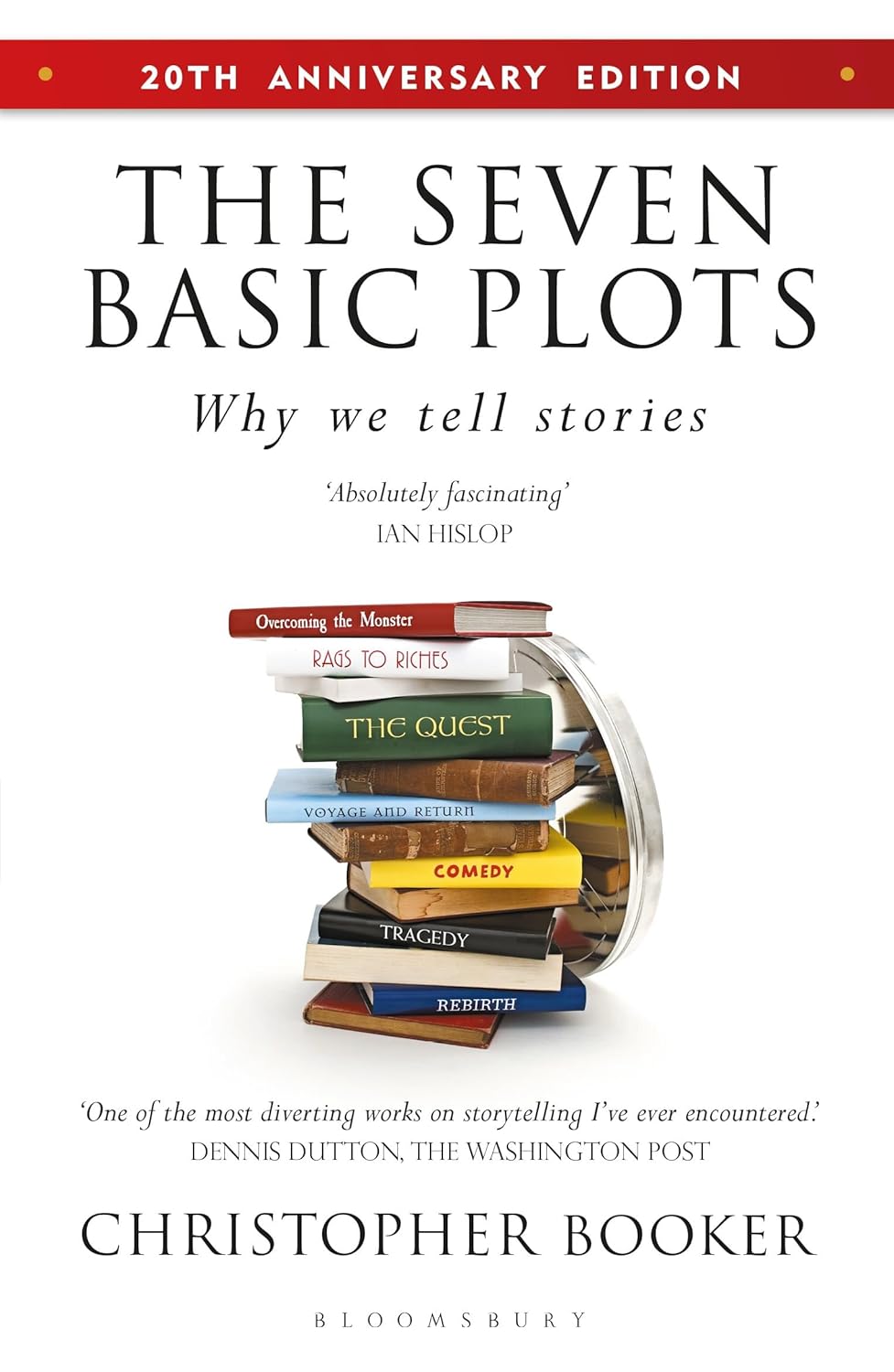
Here are seven basic plots that Booker identifies, which underpin nearly all storytelling:
Overcoming the Monster – A hero defeats a great threat.
Example: Jaws
These stories rehearse survival, showing how courage and cooperation overcome chaos.
The Quest – A journey toward a vital goal.
Example: The Lord of the Rings
Quest stories help us make sense of perseverance, sacrifice, and collective purpose.
Rags to Riches – A rise from obscurity to fulfillment.
Example: Cinderella
They explore human potential and reward moral growth.
Voyage and Return – Entering and escaping a strange world.
Example: Alice in Wonderland
These stories model adaptation, curiosity, and learning through disruption.
The Quest – A journey toward a vital goal.
Example: The Lord of the Rings
Quest stories help us make sense of perseverance, sacrifice, and collective purpose.
Comedy – Confusion resolved into harmony.
Example: Much Ado About Nothing
Comedy examines human behaviour, social error, and reconciliation.
Tragedy – A fall caused by a fatal flaw.
Example: Macbeth
Tragedy functions as moral warning, helping us understand the cost of destructive choices.
Buy Chris Booker’s The Seven Basic Plots: Why We Tell Stories: https://amzn.eu/d/71LFmfo
Or read more on Jericho Writers (a helpful website with many resources for authors): https://jerichowriters.com/how-to-write-seven-basic-plots/
Who do we write for?
Are you writing for yourself, or for the reader?
Humans are unique not just because of our brains, but because of our ability to imagine things that don’t exist. About 70,000 years ago, during what Yuval Noah Harari calls the Cognitive Revolution in his book Sapiens: A Brief History of Humankind, Homo sapiens developed this extraordinary capacity for imagination. With it came the power to tell stories—shared myths that allowed humans to cooperate in large groups. Beliefs in gods, nations, money, laws, and corporations exist only because we collectively agree they exist, yet they shape our societies in profound ways.
When it comes to writing novels, keeping your audience in mind is just as crucial. Most novelists write with the hope of being published, sharing their stories with readers who will connect, feel, and respond. If you’ve come to this website, chances are you have that goal in mind. That said, some writers write purely for themselves, and that is equally valid—storytelling is a deeply personal act, whether it reaches millions or only your own imagination.
Before you put pen to paper—or fingers to keyboard—ask yourself: who are you writing for? Imagine the kind of reader who might pick up your book. What do they care about, what excites them, and what do you want them to take away? Consider the messages woven into your story and who would benefit most from them. Writing with this awareness doesn’t limit creativity; it sharpens it, helping your story resonate with the people you most want to reach.
Ultimately, every story taps into the same human superpower Harari describes: the ability to imagine—and get others to believe in—something together. Writing is both an intimate act and a bridge between minds, connecting authors and readers through shared imagination.
Buy a copy of Sapiens by Yuval Noah Harari or read more about it here: https://www.ynharari.com/book/sapiens-2/

How these questions relate to editing
For some, the developmental editorial process can sometimes seem daunting or feel disheartening, especially when you’re deeply attached to parts of your story that an editor suggests changing. It helps to remember that an experienced editor isn’t trying to dismantle your work, but to support it, guided by thoughtful questions: how can the story be strengthened, why might it need that support, and, ultimately, who is it for? That’s why structure, plot, and keeping the reader in mind sit at the heart of a developmental edit.
To read more about Development Edits and how Lines and Curves Literary can help you, please see this webpage: https://lac-literary.com/editing/


Comments are closed