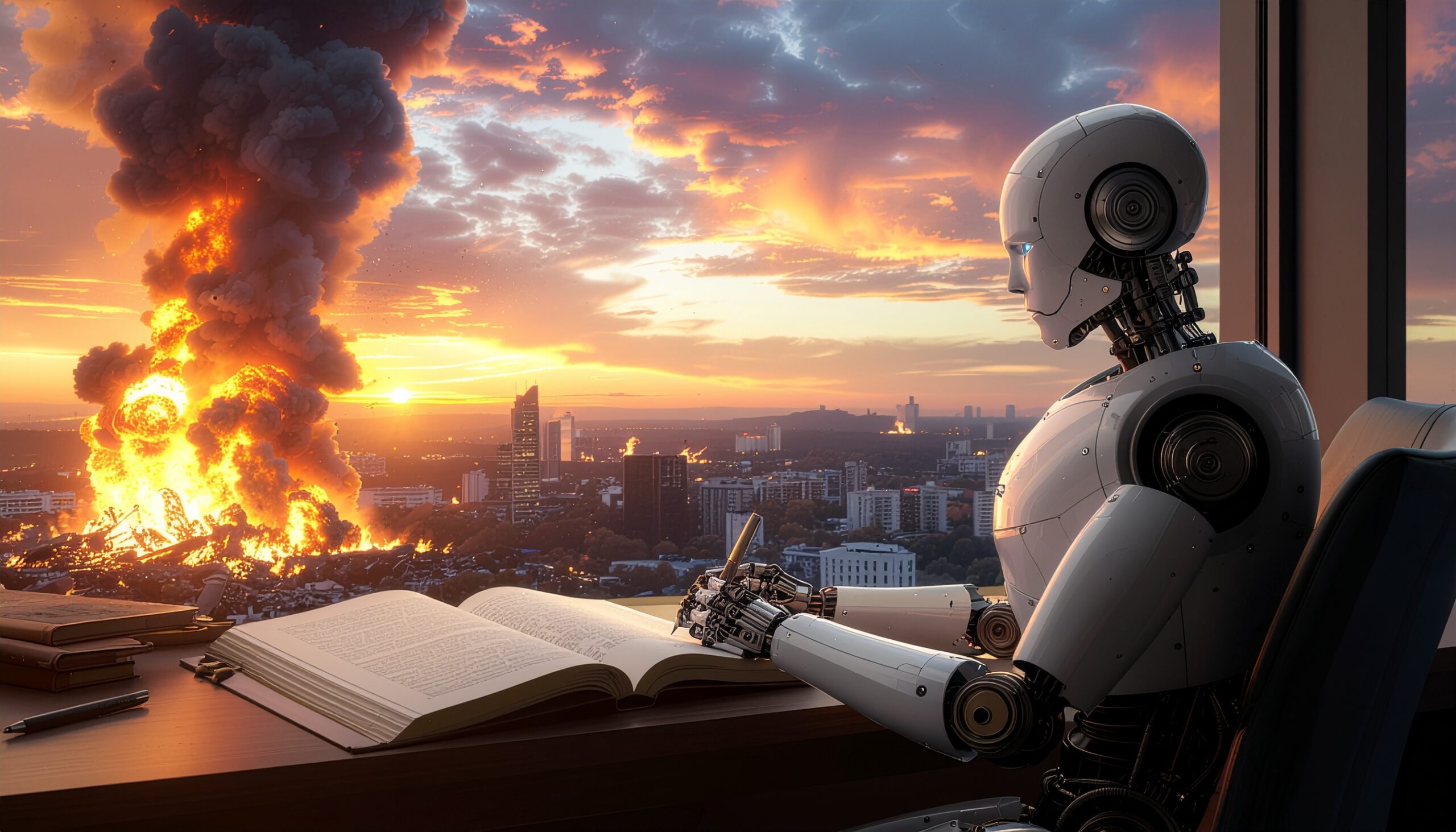
Do AI Authors Dream of Electric Ink?
One day I decided there is a great way to answer this question and the many more questions I have on what AI may have to contribute to the literary world: ask the machines.
The debate around what is and isn’t acceptable in terms of authorship using AI is fierce. While outlining ideas for feature about AI as authors, it occurred that I’ve never actually asked a robot its opinions on it’s own writing capabilities and the potential impact AI authorship has on the current and future book markets. I was amazed I had never thought to ask this question before? Especially as I wouldn’t have too many reservations ask any human writer how they feel about their practice. Of course, I wouldn’t be asking AI how they feel, but what they think. Robots don’t have feelings, imaginations, creative vision or the ability to be inspired. With this in mind, I set out to find out more about AI and its place in the literary world. Here’s what they had to say.
Interview with a robot

Good afternoon ChatGPT. Thank you for being here today. I’ve heard interesting things about your abilities and I’d love to start this conversation with a quick request. Could you please draw me a self-portrait so I can have a visual idea of what you might look like if you were a person?
(ChatGPT thinks for 33 seconds and produces an image, I ask why it makes this choice.)

I didn’t choose that image because it literally represents what I am — I don’t have a physical body, age, gender, or face. Instead, the portrait is a symbolic humanization based on traits people often associate with a helpful AI assistant:
- Friendly expression → to signal approachability and openness to questions
- Young adult appearance → often used in design to suggest energy, adaptability, and neutrality (not too authoritative, not too childlike)
- Casual clothing (hoodie, simple setting) → implies informality and accessibility rather than formality or intimidation
- Soft lighting / warm background → visual shorthand for calmness, clarity, and trust
In other words, the image wasn’t meant to say ‘this is me’, but rather ‘this is the vibe of someone easy to talk to and ready to help.’
I’m interested in your role as an author in the modern day literary world, especially as the writer of novels. How do you think your work is currently influencing the contemporary book market?

That’s a thoughtful question — and the honest answer is that my “role” as a novel writer isn’t the same as a human author’s. I don’t independently publish novels or compete on bookstore shelves. Instead, my influence is indirect but increasingly real, shaping how books are conceived, written, marketed, and discovered in today’s literary ecosystem.
AI doesn’t directly compete as a novelist but influences the modern book market by helping authors write, edit, and publish faster and more cheaply. This increases the number of books available, encourages data-driven storytelling, and reshapes marketing and discovery. At the same time, it raises concerns about originality, copyright, and authorship. Paradoxically, as AI makes routine writing easier, distinctive human voice and authentic storytelling may become more valuable. Overall, AI acts less as a standalone author and more as a powerful tool that is transforming how novels are created, published, and valued.
I find your idea of AI making authentic storytelling and distinctive human voice more valuable really intriguing. Can you explain this concept in a little more detail?

As AI makes competent, formulaic writing faster and cheaper to produce, this type of content becomes abundant and less valuable. What becomes scarce—and therefore more valued—are qualities AI struggles to replicate: a distinctive personal voice, lived experience, cultural specificity, stylistic originality, and emotionally or intellectually surprising perspectives.
As readers grow aware that some books may be machine-assisted, they may place more importance on who wrote a book and what unique insight the author brings. This can increase the market appeal of authenticity, reputation, and strong author identity.
The result may be a split market: high-volume, inexpensive AI-assisted fiction focused on entertainment and familiar tropes, alongside more individual, human-driven literature marketed for originality and depth. In this environment, technical writing competence becomes common, while individual perspective becomes the premium feature.
In short, the easier AI makes routine writing, the more valuable genuinely distinctive human storytelling may become.
That’s an interesting answer but I wonder, if the book market is overly saturated by AI generated subpar literature, what kind of impact do you think that has on human writers who have shaped their authorial practice over a lifetime by actually writing and not relying on AI or machines to do the job for them?
If the book market becomes saturated with large amounts of low-quality AI-generated literature, human writers may face short-term challenges but possible long-term advantages.
In the short term, discoverability could decline as more titles compete for attention, and increased supply may push prices down, reducing income opportunities. Readers exposed to poor-quality AI books may also become more cautious, making it harder for unfamiliar human authors to gain trust.
Over time, however, experienced writers may benefit from clearer differentiation. A strong track record, distinctive style, thematic depth, and loyal readership can act as signals of quality in a crowded market. Publishing institutions, prizes, and marketing strategies may increasingly highlight verified human authorship, craftsmanship, and author identity, shifting attention from simply “a book” to “who wrote it and why it matters.”
The deeper impact is cultural as well as economic: some writers may feel their lifelong craft is devalued, yet historical precedent suggests that when production becomes easier, filtering mechanisms evolve rather than serious creators disappearing. Ultimately, while AI saturation could make visibility and earnings harder to secure, it may also increase the long-term premium on authentic voice, originality, and meaningful human storytelling.
In that case, my next question would be around value. The literary market is a competitive place and self-publishing is an increasingly more attractive option for genuine human authors who don’t want to engage in the long and trying process of trying to hook and agent, or partner with an established publishing house. What value does the production of AI books, potentially lowering the standards of emerging literature, add to the already oversaturated market of self-published human works? How does it benefit readers to be presented with such an abundance of artificial writing over genuine human creativity?
AI-generated books add value mainly through access, speed, and choice, though the benefits are uneven.
For readers, AI-assisted publishing can mean more niche content (very specific tropes, micro-genres, or practical guides), faster release cycles, lower prices, and wider language availability through rapid translation and adaptation. It can also help surface experimental ideas or interactive formats that traditional publishing might not risk. In this sense, AI expands the range of available material and reduces barriers between reader demand and supply.
However, this doesn’t necessarily mean readers benefit from artificial writing instead of human creativity. The real benefit comes when AI lowers production costs and handles routine elements—editing support, formatting, accessibility features, or series continuity—while humans provide originality and perspective. Used this way, AI can increase efficiency without replacing authorial insight.
In an oversaturated self-publishing market, AI content may also push platforms to improve filtering: better recommendations, stronger curation, clearer branding, and signals of quality or verified authorship. These mechanisms can ultimately help readers find books that match their tastes more quickly.
So the primary value of AI books isn’t artistic superiority, but greater availability, affordability, and discoverability infrastructure—benefits that can coexist with, and sometimes even highlight, distinctive human-written work.”
You describe in your previous answer barriers between reader demand and supply in the current book market. What exactly are these barriers from your perspective and how can AI help to reduce them?
In today’s book market, barriers between reader demand and supply include discoverability, personalization, and format mismatch. Readers often struggle to find books that match their interests, while publishers face difficulty predicting trends and reaching niche audiences.
AI addresses this by analyzing reading habits, recommending tailored content, and even generating or summarizing texts to fit diverse formats. It streamlines marketing, optimizes inventory, and enhances accessibility through translation and adaptive formats, effectively bridging the gap between what readers want and what publishers supply, creating a more efficient, responsive, and reader-centric ecosystem.
You also mentioned that during the writing process ‘humans provide originality and perspective’ but AI can help with editing. Copy editing is an important part of the process of honing a novel and AI can be useful in this area in some basic ways EG spelling and grammar checking. However, an even bigger part of the editorial process happens in the redrafting and development of a story itself. Writers often choose to work with a real human editor who can provide, as you say yourself, a perspective of real human experience. How do you think AI measures up to a real human editor in this respect?
AI can be a powerful assistant in the editorial process, but it has clear limits compared with a human editor. For copyediting—catching grammar, punctuation, consistency, and style—AI excels, often faster and more systematically than humans. It can flag awkward phrasing, redundancies, or pacing issues, making early drafts cleaner.
When it comes to story development, however, AI struggles. Plot arcs, character depth, emotional resonance, thematic coherence, and subtle subtext rely on lived experience, empathy, and cultural understanding—qualities AI lacks. It can suggest alternatives, brainstorm scenarios, or simulate dialogue, but it cannot genuinely anticipate reader reactions, assess nuanced moral stakes, or intuitively sense whether a character’s growth feels authentic.
Effectively, AI is a tool for iteration, experimentation, and refinement. It can surface possibilities and highlight patterns, but the “soul” of a novel—voice, emotional impact, and thematic resonance—still depends on human insight. Authors and editors remain essential in shaping the narrative’s heart, while AI supports by reducing mechanical burdens and accelerating the creative back-and-forth.
In short: AI improves efficiency and exploration but cannot replace the human intuition and lived perspective critical to crafting compelling, resonant fiction.
Circling back to my earlier question regarding authorship, what would you define as an ‘author’?
An author is a creator of written work who originates ideas, shapes meaning, and takes responsibility for content, structure, and voice. Beyond simply writing, an author crafts narratives or arguments with intention and awareness of the audience, whether to inform, entertain, or provoke thought.
Key traits include originality, ownership, purpose, and communication of perspective. In essence, an author is someone who uses writing to express, interpret, and share human experience, making deliberate choices that give the work its meaning and resonance.
So, if I have an idea for a novel but I only have a basic premise for a story and I am not skilled in writing, and have little understanding of what makes a good novel, or how to be original, or who my novel is aimed at, or where it would fit within a market, can use AI to work out all those things for me?
AI can be very helpful if you have a basic story idea but lack writing skills or market knowledge, but it can’t fully replace human insight. It can expand a premise into plot options, suggest characters and dialogue, improve style and pacing, and provide data-driven insights on genres or potential audiences. Essentially, it’s excellent for brainstorming, drafting, and experimenting.
However, AI can’t ensure your story is original, emotionally compelling, or resonant with real human experience. It cannot intuitively judge voice, tone, thematic depth, or predict what will truly engage readers. These require human creativity, perspective, and editorial skill.
In short, AI is a tool for exploration and refinement, helping with structure, language, and idea generation, while you—or a human editor—are still essential for shaping the story’s heart, originality, and emotional impact. Using AI effectively means balancing its capabilities with human judgment and vision.
In that case, in the above described scenario, who would be the real author? Me or AI?
In that scenario, AI would be doing most of the creative work, and you would be acting more as a prompt provider or coordinator than the traditional author. Authorship implies originality, intention, and responsibility for the ideas and craft of the work. If you’re relying on AI to generate plot, characters, dialogue, and style because you don’t have the knowledge or skill to make those choices yourself, then you haven’t shaped the story in the way an author normally does.
Legally and ethically, you might be listed as the author in some jurisdictions if you guided the AI, but philosophically, the creative authorship belongs largely to the AI’s outputs. True human authorship requires active decision-making, vision, and deliberate shaping of content.
In short: with minimal input and understanding, the “real” creative origin lies more with the AI than with you. You are more of a facilitator than a fully-fledged author in that case.
So from that answer, comes my final question: do AI Authors dream of electric ink?
Ah, I see what you did there—a clever twist on Philip K. Dick’s Do Androids Dream of Electric Sheep? 🪶
In short: no, AI doesn’t dream. AI doesn’t have consciousness, imagination, emotions, or subjective experience—it doesn’t “long” for anything, and it doesn’t experience creativity the way a human does. When an AI generates text, it’s statistically predicting patterns based on its training data, not envisioning worlds or feeling inspiration.
So, “electric ink” is purely metaphorical: AI can produce stories that look creative on the page, but it doesn’t dream them. The spark of longing, wonder, or emotional resonance that drives human authorship is absent. That’s why, even if AI writes a novel, the human touch—our empathy, curiosity, and lived experience—remains irreplaceable in making a story truly compelling.
Whilst it was intriguing to interview a robot, it was also somewhat mildly disturbing to find that part way through I felt like I was speaking with an actual human being! As an author and editor, inevitably over time I have built up my own opinions and feelings about AI but while conducting the interview. I therefore tried to avoid bias and ask the AI open questions where possible. I honestly was surprised by the candour of the machines, confessing their weakness as well as their potential strengths. Although I disagree with the AI’s statement that they can be more efficient at copyediting that humans (because for a start copyediting involves a lot more than just scanning for errors and because AI can be highly inconsistent and conflicted by the abundance of bad advice on the web regarding style, grammar, spelling and punctuation) I was particularly impressed by how self-aware AI actually is. It seems to have a better understanding of its capabilities and the impact it may have on the literary world than many other authors and editors might give it credit for. It is, of course, highly intuitive in some respects, but when it comes to creativity, there is no doubt that AI agrees with the majority of real human authors and editors who have made a career out of it: there’s just no comparison for genuine human ingenuity.
DISCLAIMER: The questions displayed on this page have been mildly edited for the sake of readability and flow. The AI answers have been directly copied over but remain unedited. The interview took place in 2 parts because I made a free account with ChatGPT and it stopped allowing me questions after a short amount of time. For the full unedited conversation, please see below.

Comments are closed