Style Guides: For Punctuation
Whose style are we talking about exactly?
In fiction, style lays the road, substance paints the scenery—without both, your story goes nowhere.
You’ve likely heard the phrase “style over substance,” (usually as a warning) but in fiction writing, style and substance aren’t competing priorities, they’re partners. When it comes to style guides, we aren’t talking about an authors particular style of writing but the elements of writing which pave the way for the reader to understand and follow the story. Think of style as the rules of punctuation, grammar, and formatting: the commas, dashes, quotation marks, and paragraph structures that guide the reader smoothly through your words. Substance, on the other hand, is the authorial voice, sometimes called ‘writing style’. This is the unique personality, tone, rhythm, and word choice that makes your writing unmistakably yours. Without substance, style is empty and mechanical; without style, substance can be confusing or hard to follow. In fiction, both matter equally: style frames the story, and substance brings it to life.
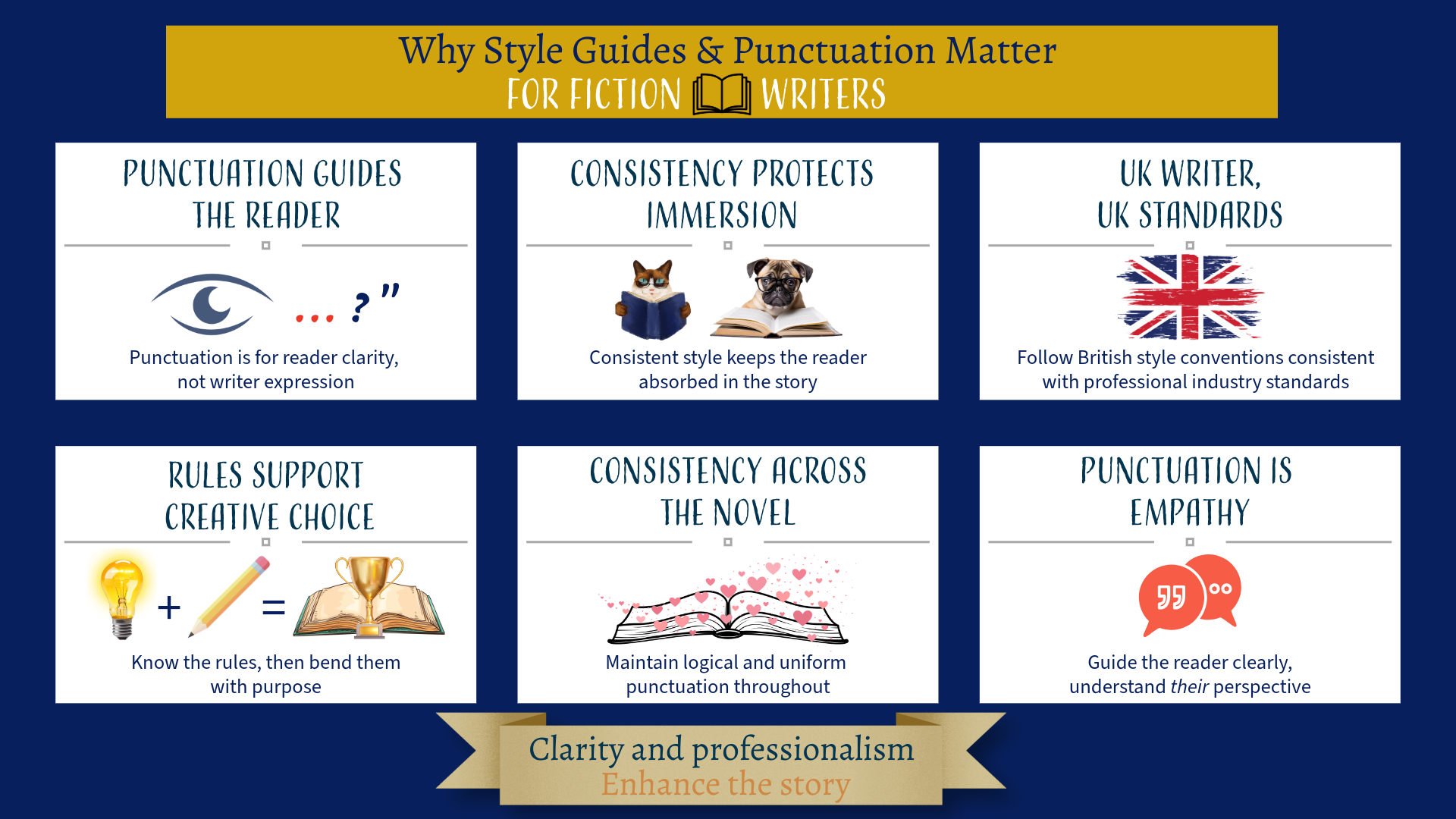
Fiction may be art, but it is also a craft, and one of the most underestimated tools in that craft is punctuation. Style guides exist not to stifle creativity but to support it, quietly and invisibly, by helping writers manage the reader’s experience of the text. For fiction writers—particularly in the UK—understanding why style guides matter, and why punctuation is for the reader rather than the writer, is essential to producing professional, immersive work.
Punctuation Exists for the Reader, Not the Writer
At its core, punctuation exists to guide the reader through meaning. Writers often hear rhythm, emphasis, and tone in their heads as they write, but readers cannot hear any of that. They encounter only marks on a page. Commas, dashes, quotation marks, and full stops act as navigational tools, telling the reader how ideas are grouped, where pauses belong, and what information is essential or incidental.
When punctuation reflects the writer’s feelings rather than the reader’s needs, confusion follows: rereading, misinterpretation, or subtle irritation that pulls the reader out of the story.

Why UK Fiction Writers Need UK Style Guidance
For UK fiction writers, guides such as New Hart’s Rules or Fowler’s Dictionary of Modern English Usage offer authoritative grounding in British punctuation conventions: single quotation marks, logical placement of punctuation, guidance on use of the serial comma, and careful treatment of dashes and ellipses.
These guides are not written specifically for fiction, but they reflect the standards UK editors and publishers expect. Using them removes unnecessary friction when submitting work and signals professionalism long before anyone comments on plot or voice.
Another reason it is important for UK writers to understand and work with style guides, lies in the differences between punctuation used in UK English and US English—and vice versa! Style Guides such as The Chicago Manual of Style, offer comprehensive guidance to US writers.

Consistency Across a Long Body of Work
Novels magnify small decisions: how thoughts are represented, how interruptions appear in dialogue, how pauses are marked. A style guide provides default answers so the writer does not have to reinvent these decisions repeatedly.
This consistency reduces cognitive load—for both for the writer and the reader—freeing mental energy for storytelling itself.


How Style Guides Protect Immersion
Style guides provide a shared, conventional framework that readers already understand, often unconsciously. When punctuation follows familiar patterns, it disappears; the reader stops noticing the mechanics and sinks into the narrative.
Inconsistency, on the other hand (shifting quotation styles, erratic dash usage, or fluctuating comma habits) forces the reader to keep recalibrating. That mental effort breaks immersion, even when the story itself is strong.
Rules Create Freedom, Not Constraint
Style guides do not eliminate creative choice, they make it deliberate. Knowing the conventions allows writers to bend or break them with purpose. An unconventional dash, fragment, or omission works only because the reader recognises the norm being disrupted.
Without that shared baseline, expressive punctuation becomes noise rather than meaning.

Punctuation as Empathy, providing Clarity to the Reader
Ultimately, punctuation is an act of empathy. It acknowledges that the reader does not share the writer’s internal context and supplies the cues needed to reconstruct meaning accurately. Style guides formalise that empathy, not to constrain imagination, but to support clarity.
For fiction writers, style guides are not rulebooks to obey blindly. They are tools that help the physical presence of the writing fade into the background, so story, character, and voice can take centre stage.
Which Style Guide Should I Choose?
This is a good question, but because everyone has different preferences when it comes to style, it is best for you to decide for yourself. Style Guides differ in a number of ways. As a UK Writer and Editor, I would recommend considering the following three UK Style Guides for British writers.
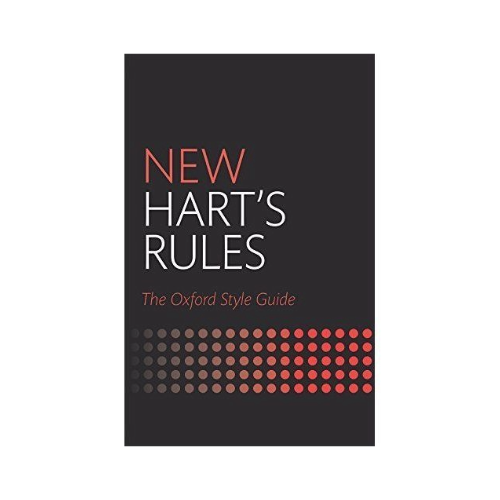
The de facto British editorial standard style guide, used widely by UK publishers and editors. Contains comprehensive rules for punctuation, quotation conventions (e.g., UK norms for quotes), Endorses the use of the Oxford comma (aka the serial comma), hyphenation, dashes, etc.
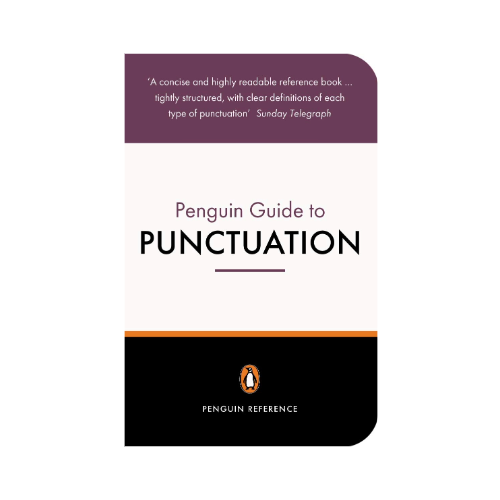
A relatively accessible, example-rich guide to punctuation aimed at writers (not just professional editors). George Davidson’s book walks through practically every punctuation mark with clear examples. A good choice for first time authors or those who are new to style guides.
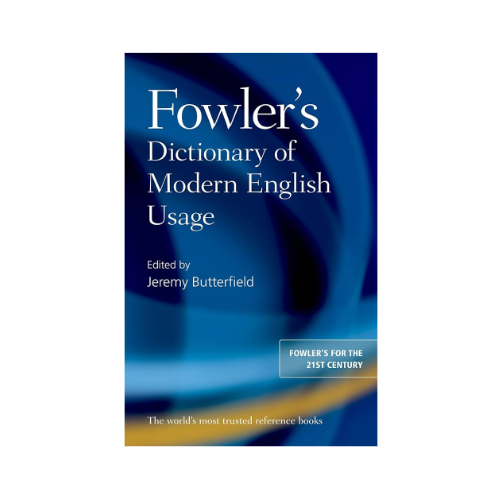
Classic UK usage reference style guide and dictionary with insightful entries. on punctuation, widely respected in British literary circles. Good for deeper decisions about usage, tone, and complex punctuation. It treats language as something living and flexible, with guidance less constrained or formulaic.
For US writers the top three recommended style guides would be:
– The Chicago Manual of Style (CMOS): this is the gold standard for US fiction publishing. It covers dialogue punctuation, dashes, italics, hyphenation, numbers in narrative prose, and manuscript preparation in serious depth. Most US trade publishers either follow Chicago directly or base their in-house style on it, which makes it the single most useful reference for novelists.
– Dreyer’s English: An Utterly Correct Guide to Clarity and Style: written by the former copy chief of Random House (Benjamin Dreyer), this is a practical, writer-friendly guide grounded in real fiction editing. It explains punctuation and usage decisions with humour and clarity, helping writers understand how rules actually function in published novels rather than in theory.
– Garner’s Modern English Usage: A respected, detailed usage guide that helps writers make nuanced decisions about grammar, punctuation, and word choice. While not fiction-specific, it’s widely used by professional editors and is especially helpful when navigating grey areas or stylistic judgement calls.
Style Guide vs Style Sheet
You may have heard of the term ‘Style Sheet’ and wondered what is the difference between a style sheet and style guide. The truth is, sometimes, throughout the literary and publishing worlds, these two terms are used interchangeably, but Lines and Curves Literary and many other writers and editors out there would define them as two separate things: a style guide is a comprehensive set of rules regarding punctuation, formatting and some nuisances of grammar; a style sheet is a breakdown of particulars of style favoured by an author and/or editor. Style sheets are particularly useful in the author/editor relationship, to provide clarity around elements such as proper nouns, preferred use of punctuation such as speech marks, guidance on characters and timelines (especially useful in Fantasy and Science Fiction novels or series), typesetting and other formatting particulars for a manuscript or proof file.
For more information regarding style sheets and guidance for writers on how to compile one, please see this post: https://lac-literary.com/a-simple-guide-to-style-sheets/


Comments are closed